
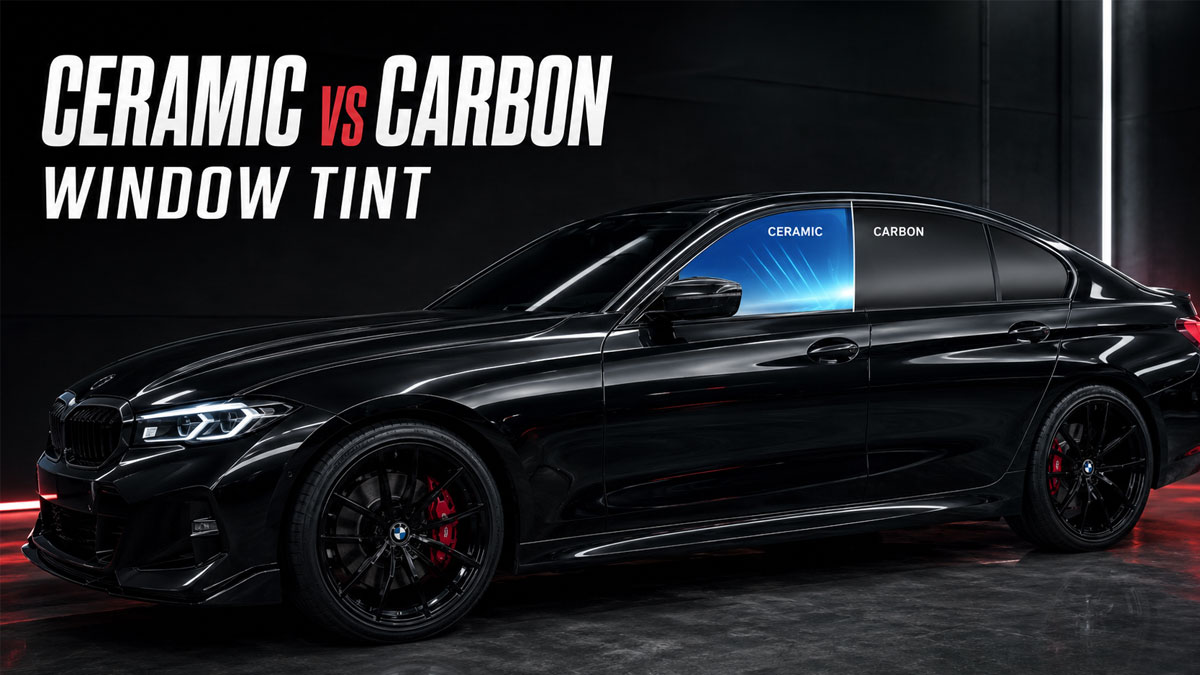
When we want to protect a car from direct sunshine, two options are always most desirable: ceramic and carbon window tint; however, the question is which one is more effective? Overall, ceramic window tint offers maximum heat rejection, optical clarity, and long-term performance. Whereas carbon tint costs less than ceramic, it delivers UV protection, a non-reflective appearance, and respectable heat control. At GT Auto Styling, we install XPEL’s ceramic and carbon window tints with premium quality and skilled staff.
What Is Carbon Window Tint?
Carbon window tint is a mid-range protective film applied to windows to protect passengers and the interior of the car from UV rays and direct sunlight. These films are made of microscopic carbon particles and, despite the name, are not solid films; they have a multilayer structure. The main parts of carbon window tints are polyester, adhesives, protective coatings, and a carbon-containing layer. XPEL PRIME CS is the best example of a carbon window tint designed for everyday protection and is more affordable than other types of tinting.
What Is Ceramic Window Tint?
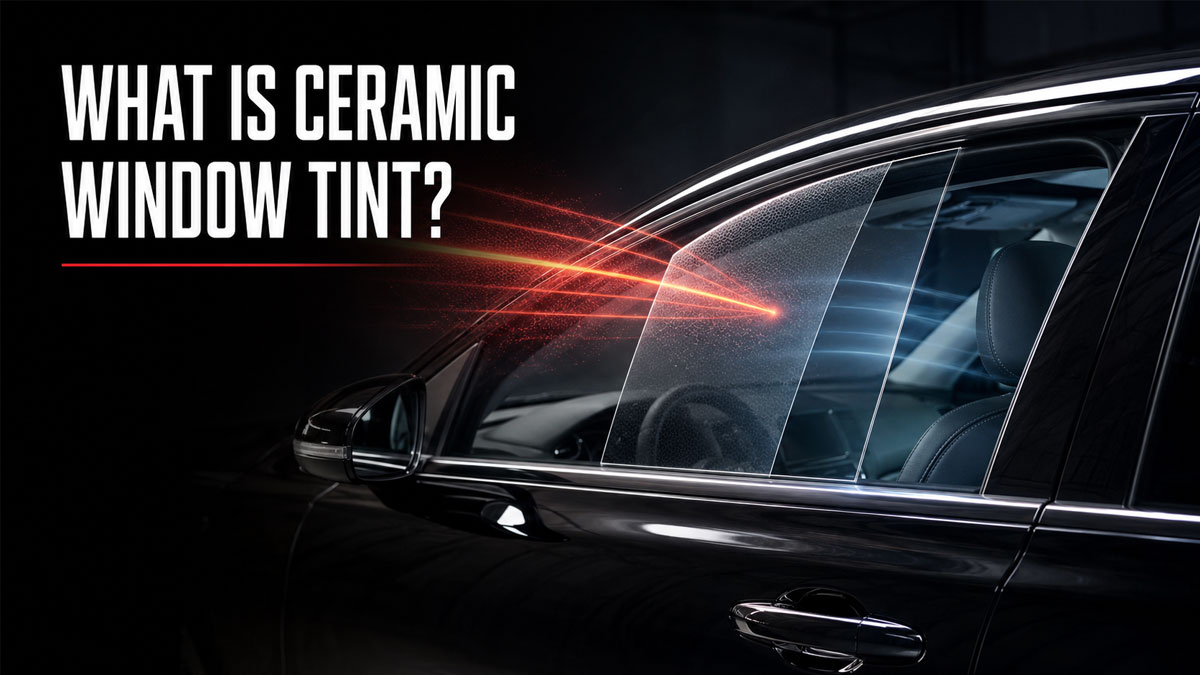
Ceramic window tint is the most premium option for protecting passengers and the interior, offering all the carbon window tint features and also absorbing solar energy, such as infrared energy. Ceramic window tints are made of premium laminated film containing polyester layers, adhesives, protective coatings, and a nano-ceramic component. The greatest feature of ceramic window tint is its ability to reject heat, while you can choose the darkness type you need. XPEL PRIME XR and XR PLUS, for example, are nano-ceramic films developed for stronger infrared control and cabin comfort. They offer the following advantages to all drivers;
- High infrared heat rejection
- Strong total solar-energy rejection
- Up to 99% UV protection, depending on the product
- High optical clarity
- Glare reduction
- Colour-stable performance
- No metallic signal interference
- Multiple shades, including very light films
Ceramic vs Carbon Window Tint: Key Differences
Carbon and ceramic films are both non-metalized, signal-friendly options, but they do not deliver the same level of heat control, and they may vary in many key points.
| Feature | Carbon tint | Ceramic tint |
| Film technology | Carbon-containing layer | Nano-ceramic particles |
| Heat rejection | Moderate | High to very high |
| UV protection | Excellent in quality films | Excellent in quality films |
| Optical clarity | Good | Usually superior |
| Glare reduction | Depends mainly on shade | Depends mainly on shade |
| Signal interference | None | None |
| Colour stability | Good | Excellent |
| Available shades | Light to very dark | Light to very dark |
| Typical cost | Lower | Higher |
| Best suited to | Privacy and everyday protection | Maximum comfort and performance |
Which Tint Offers Better Heat Rejection?
Both ceramic and carbon tints offer desirable heat rejection; however, ceramic tints with the same level of darkness offer better heat control and can also absorb a broader and more heat-intensive part of the solar spectrum. GT Auto Styling’s experience shows that when premium ceramic tints such as XPEL are installed, cabin heat is reduced more than with carbon tints, and this is more obvious in Vehicles with panoramic roofs and large SUVs.
Carbon vs Ceramic Tint for UV Protection
One of the main reasons why many install window tints is to protect their skin and car’s interior design from UV rays. Data shows that XPEL’s tints can block up to 99% of UV rays. Therefore, UV protection alone may not justify upgrading from carbon to ceramic.
Which Window Tint Provides Better Visibility?
The main thing to pay attention to when installing window tints is visibility, and this is exactly where ceramic tints have the upper hand. When the car faces lighter shades, premium ceramic tints such as XPEL provide better optical clarity than carbon tint.
| Comparison or Issue | Effect on Visibility |
| 50% ceramic vs. 20% carbon | The 50% ceramic tint generally provides better nighttime visibility because it allows more visible light to pass through. |
| 20% ceramic vs. 50% carbon | The 20% ceramic tint is considerably darker, despite using more advanced film technology. |
| 5% carbon or ceramic tint | Either film can make pedestrians, cyclists, curbs, and unlit objects difficult to see at night. |
| Optical distortion | Makes objects appear warped or unclear through the glass. |
| Excessive haze | Produces a cloudy appearance, especially under direct sunlight or headlights. |
| Interior reflections | Creates distracting reflections on the inside of the window. |
| Adhesive irregularities | Cause visible patches, lines, or inconsistent clarity. |
| Contamination beneath the film | Traps dust and debris, creating spots or raised areas. |
| Uneven edges or creases | Distort the view and reduce the quality of the installation. |
Is Carbon Window Tint Darker Than Ceramic Tint?
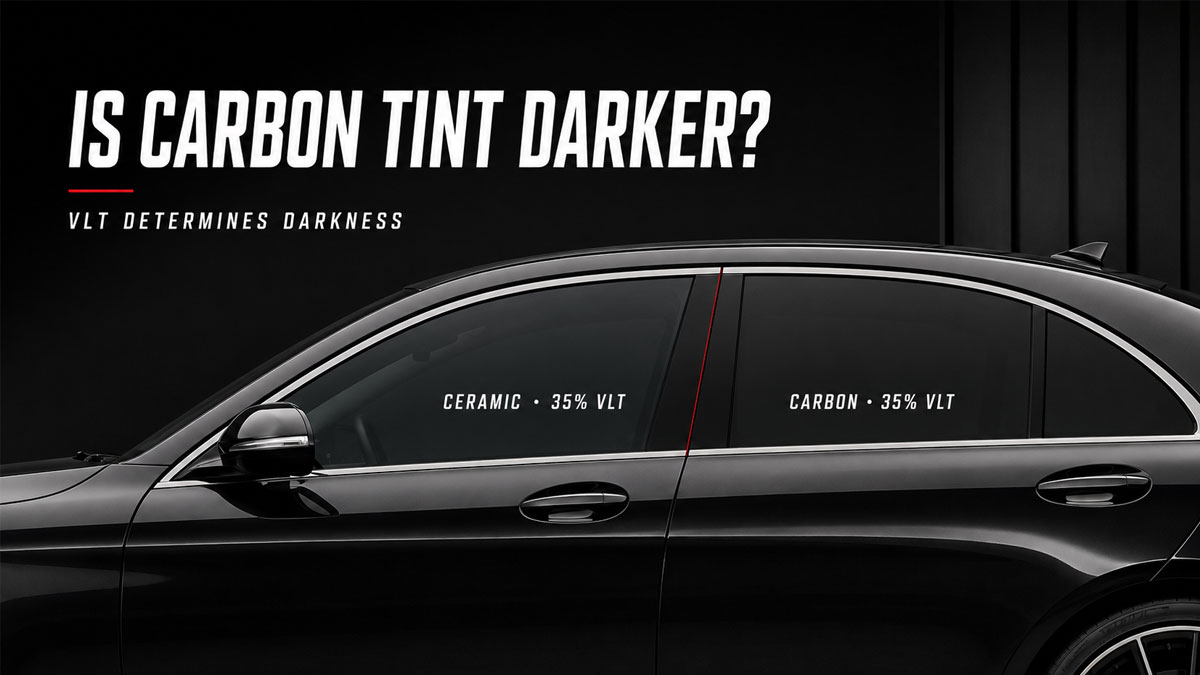
One thing that all drivers should know is that there is no difference in the darkness of ceramic and carbon. Experience shows that a 20% ceramic film and a 20% carbon film should have a broadly similar darkness level. So if the darkness is important for you, both offer the same level of darkness.
Carbon vs Ceramic Tint: Durability and Lifespan
It is obvious that ceramic tint is more durable and it comes with a longer lifespan compared to carbon window tint. However, brand is also important; for example, XPEL carbon window tint comes with an 8-year warranty, while many other brands offer at most a 2-year warranty. A good carbon film can remain stable for years without significant fading or discoloration. Premium ceramic films are usually designed for even greater colour stability and resistance to bubbling, delamination, and optical deterioration.
Ceramic vs Carbon Window Tint Price
Since ceramic window tint offers more durable and premium films than carbon, it will cost more than any other type of film. Carbon tint is usually the more economical choice for drivers who want:
- UV protection
- A darker appearance
- Additional privacy
- Moderate heat reduction
- No electronic-signal interference
GT Auto Styling offers XPEL carbon and nano-ceramic options at different performance and price levels.
Pros and Cons of Carbon Window Tint
Carbon window tints are full pros; however, they are not suitable for all cars and drivers. Each person, depending on the situation, should choose a specific type of window tint and the following table can help you decide whether it is the best choice for you or not.
| Advantages of Carbon Window Tint | Disadvantages of Carbon Window Tint |
| More affordable than ceramic film | Provides less heat rejection than premium ceramic film |
| Offers a stable, non-reflective appearance | Is less effective on large windshields and panoramic roofs |
| Resists fading better than inexpensive dyed tint | May require a darker shade to achieve the desired cabin comfort |
| Provides effective UV protection in premium products | Optical clarity can vary between brands |
| Delivers moderate heat rejection | Does not offer the highest level of infrared control |
| Improves glare control and passenger privacy | Lower-priced films may use weaker adhesives or protective coatings |
| Does not interfere with GPS, radio, Bluetooth, or cellular signals | Performance depends heavily on product and installation quality |
| Comes in multiple shades | Cannot match the overall performance of premium ceramic tint |
Pros and Cons of Ceramic Window Tint
To tell the truth, the only disadvantage of ceramic window tint is the higher cost compared to other kinds of window tint. However, if you are looking for the best option to protect your car and body, ceramic window tint is the best option. The table below will shed light on both pros and cons of ceramic window tints;
| Advantages of Ceramic Window Tint | Disadvantages of Ceramic Window Tint |
| Provides superior heat rejection at comparable VLT levels | Has a higher initial price than carbon tint |
| Delivers strong infrared-energy control | Performance varies considerably between brands |
| Maintains high optical clarity | Low-quality ceramic films may produce noticeable haze |
| Offers excellent UV protection | Advertised IR-rejection percentages can be misleading without TSER data |
| Provides strong colour stability | Cannot prevent all cabin heat buildup |
| Does not interfere with GPS, radio, Bluetooth, or cellular signals | Does not protect the glass from stone chips or impacts |
| Performs effectively in lighter shades | May be unnecessary for vehicles used infrequently |
| Works well on windshields and panoramic roofs | May offer limited value for vehicles normally parked indoors |
| Reduces the need for extremely dark tint to achieve cabin comfort | Requires professional installation to deliver its intended clarity and performance |
Is Ceramic Tint Worth the Extra Cost?
The answer to this question lies in what you are looking for when you want to apply window tint. If full protection suits you more than anything, then the extra cost is worth it. However, if you are looking for something simple, do not pay extra and go for XPEL PRIME CS.
Ceramic or Carbon Window Tint: Which Is Best for Your Car?
At GT Auto Styling, we always pay attention to details and then offer the best option. Choosing the best window tint is the same: first, we evaluate what matters to you and, depending on your car model, offer the right solution. For Toronto and the whole GTA, we always offer ceramic window tint because UV rays can harm your skin and destroy your car’s interior. We also offer XPEL PRIME CS, a carbon window tint for sedans and drivers who want affordable films.
FAQ
Which Is Better, Carbon or Ceramic Window Tint?
It is obvious that ceramic window tint offers better heat rejection and optical clarity. However, carbon tints, with their lower price, offer reliable performance.
Which Tint Lasts Longer, Carbon or Ceramic?
Ceramic window tint is more resistant to fading and, as a result, has a longer lifespan.
Does Ceramic Tint Look Different from Carbon Tint?
After installation, ceramic tint looks more refined, while carbon tint is darker.
Does Ceramic Tint Interfere with Electronic Signals?
Ceramic tint is non-metalized and will not interfere with GPS, Bluetooth, radio, or cellular signals.
Read More


