If you are tired of excessive summer heat and direct sunlight damaging your vehicle’s interior, applying window tint is the most effective way to keep your car cool. No-brand tints look good, but are they also effective against direct sunlight? Can they really cool down your car? The short answer is no, they are not that effective; however, unlike fake companies, brands such as XPEL, 3M, or even LLUmar offer full protection against direct sunlight, which will keep your car cooler. At GT Auto Styling in Markham, we install XPEL window films for drivers across Toronto and the GTA. XPEL data sheet shows that the PRIME XR Plus series can block 99% of UV rays and offer significantly higher heat rejection than a basic tint.
How Window Tint Reduces Heat Inside Your Car
Window tints are designed to absorb solar energy effectively; as a result, they can control how much passes through the glass. In case a window is not tinted, visible light, ultraviolet rays, and infrared radiation enter the cabin so that the seats, dashboard, and steering wheel absorb the energy and release it as heat. Since window tints offer three effective features known as visible light transmission (VLT), infrared rejection, and total solar energy rejected (TSER), they will control cabin temperature easily. Experience shows that high-quality window tint can reduce infrared heat, block more than 99% of harmful UV rays, keep interior surfaces cooler, and help the air conditioner cool the cabin faster. However, a darker tint does not always reject more heat, so TSER and infrared performance should be considered alongside VLT.
How Much Cooler Can a Tinted Car Get?
There is no scientifically proven number that shows how much a tinted car can control a car’s temperature; however, experience shows that actual cabin temperature depends on several factors:
- Outside temperature
- Amount of direct sunlight
- How long is the car parked
- Windshield size
- Total glass area
- Vehicle colour
- Interior colour
- Tint coverage
- Film technology
- Tint shade
- Whether your sunroof or panoramic roof is tinted
In real-world testing, parked vehicle cabins can rise more than 20°C above ambient temperature, and much of the heating happens quickly. So tint does not magically turn a car parked in full sun into an air-conditioned room. It reduces the rate and intensity of solar heat entering through the glass. You will usually notice the difference most when you enter the vehicle, touch the steering wheel and seats, or start using the A/C.
Why Ceramic Window Tint Is Better for Heat Rejection
If you ask all the experts about the best way to reject heat, there’s no question they will recommend ceramic window tint, and they all have good reasons. Instead of relying primarily on darkness, ceramic films use advanced particles designed to control solar and infrared radiation while maintaining good optical clarity. At Gt Auto Styling, we use only top-notch XPEL tints that truly keep the car’s interior cool all summer.
|
XPEL Tint |
Type | Heat / IR Performance | UV Protection |
| PRIME CS | Carbon | Approx. 26% heat rejection* |
99% |
|
PRIME HP |
Hybrid | Approx. 46% heat rejection* | 99% |
| PRIME XR | Nano-ceramic | Up to approx. 88% IR rejection* |
99% |
| PRIME XR PLUS | Advanced nano-ceramic | Approx. 95–98% IR rejection* |
99% |
Will Your Car Still Get Hot With Ceramic Tint?
Ceramic tints are effective at keeping the car’s interior cool, but they will not eliminate heat entirely. You should consider ceramic tint as a form of insulation in a house. It can transfer heat throughout the house, but is that enough to keep the house cool in a hot summer? Surely not! The main feature that a proper ceramic tint offers is as follows;
- Less solar energy enters through the glass
- Seats and trim absorb less radiant heat
- The steering wheel may feel less aggressive under the direct sun
- Your A/C has less heat to fight after you start driving
- Passengers sitting beside large windows feel less radiant heat
Does Darker Tint Mean Better Heat Protection?
One of the biggest misunderstandings about installing window tints is that people think that if it is darker, it will keep cars cooler. Nevertheless, the main reason that cars are colder is the small particles that give features such as VLT and TSER.
Ceramic, Carbon, and Dyed Tint for Heat Rejection
As we have already established, the type of tint used is extremely important for keeping the car cool, and below, we have indicated which type of tint is most useful for Ontario drivers.
|
Tint Type |
Heat Control | UV Protection | Clarity |
| Dyed | Basic | Varies |
Good |
|
Carbon |
Moderate | Good | Good |
| Hybrid | Moderate–High | Very Good |
Very Good |
|
Ceramic |
High | Excellent | Excellent |
| Advanced Ceramic | Very High | Excellent |
Excellent |
Is Window Tint Worth It for Toronto Summers?
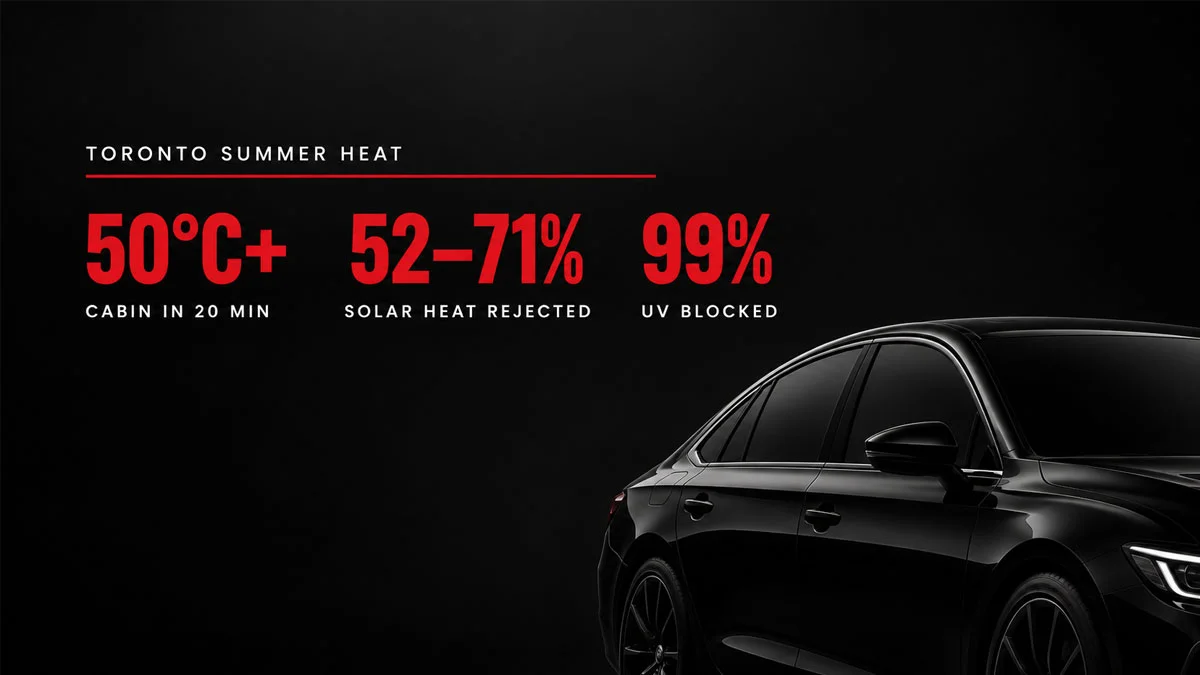
If your car spends a lot of time outside or you drive daily across Toronto and the GTA, window tints are effective in reducing the interior’s temperature. Toronto’s average daytime high reaches about 27°C in July and 26°C in August, but the inside of a parked vehicle can become much hotter than the air outside. Transport Canada reports that even on a 20°C day, the temperature inside a previously air-conditioned vehicle can rise above 50°C in as little as 20 minutes. That heat builds up because sunlight passes through the glass, warming the dashboard, seats, steering wheel, and interior panels.
A high-quality ceramic tint helps by reducing the amount of solar energy entering the cabin. For example, XPEL PRIME XR PLUS can reject roughly 52% to 71% of total solar energy, depending on the shade, while blocking 99% of UV rays and rejecting up to 96% of infrared energy at 1025 nm. For drivers spending 30–60 minutes or more commuting on the 401, DVP, Highway 404, or other GTA roads, that can mean less radiant heat on your skin, cooler interior surfaces, better UV protection, and less work for your A/C during hot summer drives.
Choosing the Right Window Tint for Toronto and GTA Driving
If you are going to choose your window tint solely by watching a TikTok video, you are on the wrong road. All the drivers should consider their own needs, car model, and what they are looking for. If you don’t have the knowledge, we at GT Auto Styling offer a free consultation to help you choose the best option for your needs.
Keep Your Car Cooler With GT Auto Styling
You cannot control a Toronto heat wave, and you definitely cannot move the sun. However, you can control how much of that solar energy gets through your windows. GT Auto Styling offers 4 levels of XPEL window tint, from affordable carbon film to advanced XR PLUS ceramic tint, so you can choose based on your budget, heat-rejection needs, privacy, and desired appearance. If heat is your main concern, ask us about XPEL XR and XR PLUS ceramic tint.
Window Tint and Car Temperature FAQs
Does Window Tinting Help to Cut Air Conditioner Use?
“Yes, Quality window tint blocks some of the solar heat entering through the glass, allowing the cabin to cool faster and reducing the load on the A/C (particularly on long summer drives or after parking in direct sun).
How Much Cooler Is a Car With Window Tint?
There is no magic number, as the temperature in the cabin depends on outside temperature, parking time, glass area, vehicle color, and type of film.
Does Ceramic Tint Keep A Car Cooler Than Regular Tint?
Usually, Yes. Ceramic tint is meant to block more infrared and solar energy than basic dyed film. Premium options like XPEL ceramic tint can also block up to 99% of UV rays, helping protect passengers and interior materials alike.
Read More