
Quick PPF installation is one of the most important factors for many drivers, but is it worth sacrificing quality for speed? A perfect, edge-less finish needs precision, dedication, template cutting, and expertise; that is why an installer may need more time. Depending on the car model and the PPF coverage, the installation can take from 1.5 hours to several days. For small sedans, partial PPF can be applied in less than 3 hours, but for larger vehicles, like a Rivian SUV or the Tesla Cybertruck, installation can take more than a day. At GT Auto Styling, we’ll give you detailed information on how long it takes to install PPF on cars and factors that may affect your appointment.
Average Duration for PPF Installation
The installation process for each car is different, and several factors, such as vehicle size, the areas being protected, and the installer’s know-how, influence it. Based on these factors and our experience, we have prepared a table to give you a better idea.
| PPF Coverage | Typical Time to Plan For |
Why It Takes This Long |
|
Small areas |
A few hours | Door cups, edges, mirrors, and similar sections require limited film |
|
Partial front coverage |
Several hours |
Usually involves sections of the hood, fenders, mirrors, and other impact zones |
|
Full front PPF |
Most or all of a working day | Bumper, full hood, full fenders, and mirrors require more positioning and edge finishing |
| Full-body PPF | Around 2–3 days |
Every major painted panel must be prepared, fitted, installed, and inspected |
| Full-body PPF with paint correction or complex preparation | Potentially longer than 3 days |
Paint defects, contamination, coatings, or difficult vehicle geometry add preparation time |
Factors Affecting Installation Time Of PPF
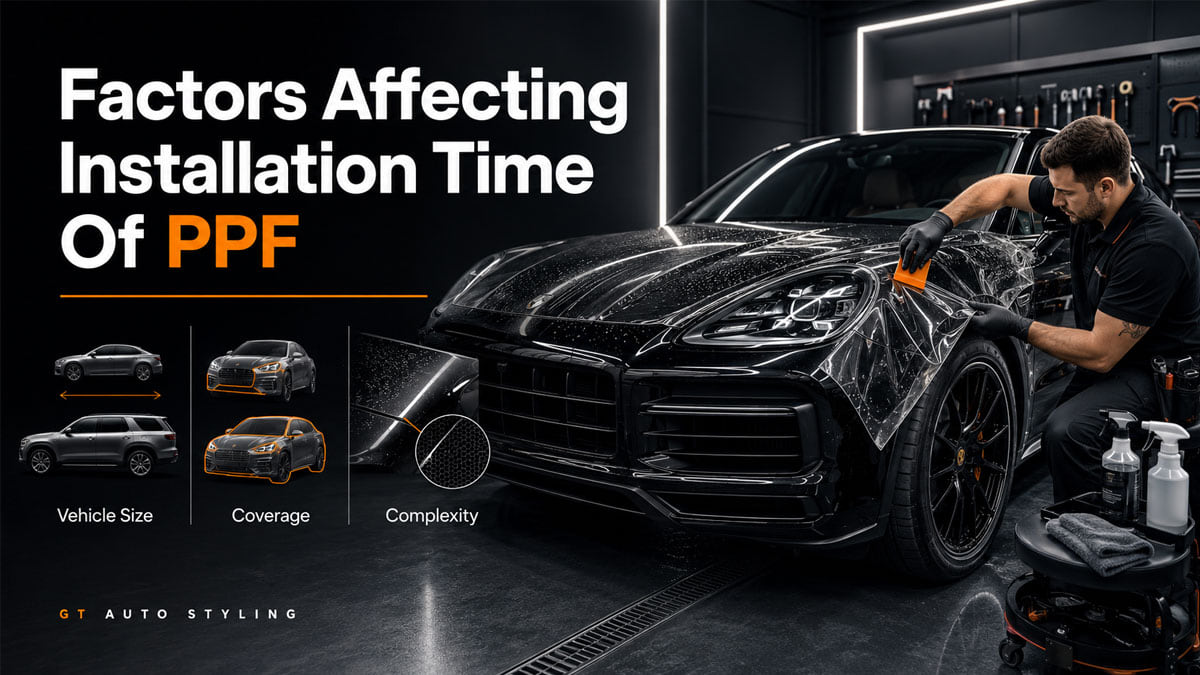
Based on our experience installing XPEL PPF on different vehicles, every project has its own timeline. The following factors can influence the installation process:
Amount of PPF Coverage
How much PPF will be applied to your car and which parts will be protected are important factors in installation time. A partial PPF that protects the partial-front package can be done in a few hours on sports cars such as a Porsche. However, full-body PPF expands the work to doors, rear quarter panels, rocker areas, the trunk, the roof, and other painted surfaces, which will surely take more time.
Vehicle Size and Body Design
Installing PPF on large cars such as Rivian models, Toyota Land Cruisers, and Tesla Cybertrucks has always been time-consuming; however, car design is also important. For example, installing PPF on a Rolls-Royce, which requires precision, will take longer than usual. When installing PPF, every curve, door, recess, sensor, air intake, and edge matters and will take more time. At GT Auto Styling, we use precision-cut templates to install PPF along all edges, which is why we deliver a clean, seamless appearance.
Paint Condition
The pre-installation condition can truly affect the timing of the PPF installation process. The main purpose of the PPF is to preserve the car’s beauty, and if the paint is already damaged, that should be addressed first. Of all the pre-installation conditions that we can mention, the following are the most important ones;
- Heavy contamination
- Tar
- Water spots
- Overspray
- Swirl marks
- Adhesive residue
- Wax or sealant buildup
Existing Ceramic Coating
Usually, we install ceramic coats over PPF, but installing PPF over an existing ceramic coating is generally not recommended. Since ceramic coating can make the surface unstable, we usually apply ceramic coating over PPF. However, an existing ceramic coating may interfere with film adhesion. Before installation, we inspect the surface and determine whether polishing or coating removal is necessary.
Edge Wrapping and Finish Level
When we claim that our projects are edge-to-edge and seamless, it is because we spend more time than other installers. Using precision-cut templates, we detect all edges and install them carefully. This process takes more time, but it improves the lifespan of the PPF and delivers a perfect installation.
Installation Environment
Over winter and summer, a temperature-controlled room plays a vital role in the timing of the installation. 3M and XPEL recommend a temperature-controlled room at 16°C to 30°C (60°F to 85°F), with 21°C to 26°C (70°F to 79°F) preferred for easier, more controlled PPF application.
Step-by-Step PPF Installation Process
When drivers want a perfect PPF installation, the process is completely different from a DIY process. Before installation, every dent should be analyzed, the car should be corrected, and then, when the car is in the best condition, we start applying the PPF to your car. What makes GT Auto Styling a unique PPF installer within Toronto and all across Ontario is our process, which involves;
Step 1: Vehicle and Paint Inspection
Step 2: Washing and Decontamination
Step 3: Paint Preparation
Step 4: Pattern Preparation
Step 5: Film Positioning
Step 6: Squeegee and Moisture Removal
Step 7: Edges and Complex Areas
Step 8: Drying and Final Inspection
Tips for a Faster Installation
Keep in mind that pressing the elevator button harder won’t make it come faster! So if you rush the PPF installer, the process won’t be done faster than usual. We first inspect cars at GT Auto Styling so customers receive a realistic estimate and avoid unnecessary delays.
- Booking your coverage package in advance
- Telling the shop about existing ceramic coating
- Disclosing any repainting or body repair
- Informing the installer about existing PPF or vinyl
- Discussing paint correction before appointment day
- Removing personal belongings if interior access is needed
- Avoiding waxes, sealants, or coatings immediately before installation
- Arriving at the scheduled time
Quality vs. Speed in Installation
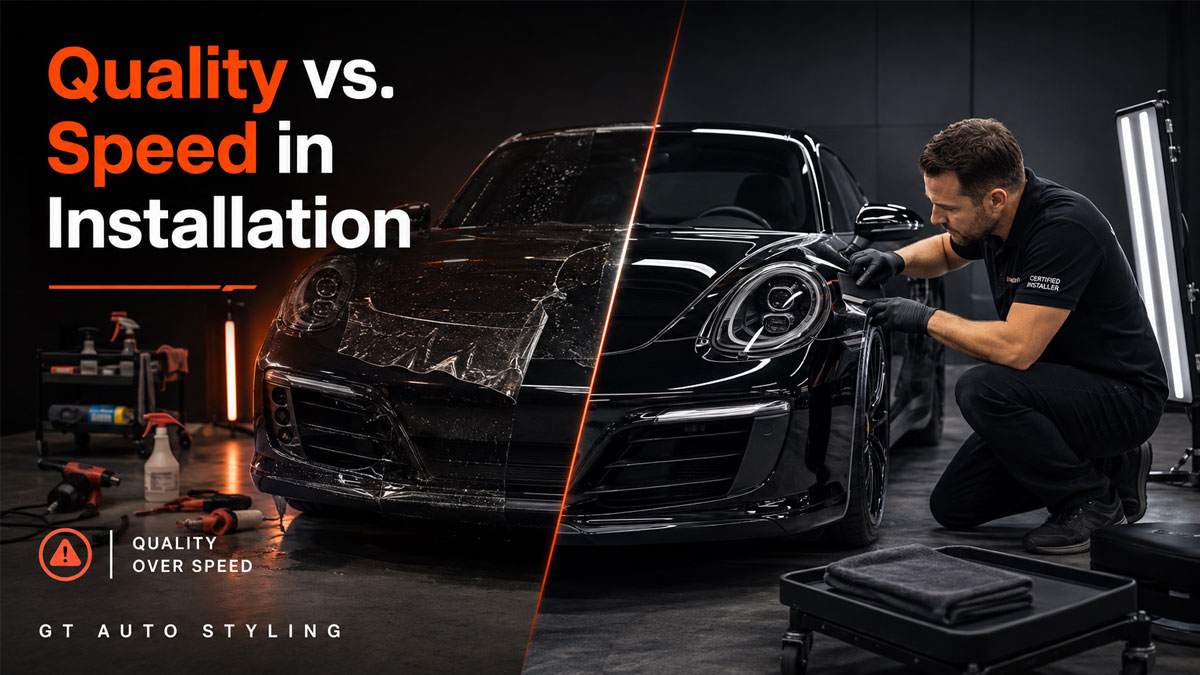
When comparing PPF installers, the fastest completion time should rarely be the deciding factor. Imagine two installers will install PPF for the same price. One installer asks for enough time to clean the car, inspect the paint, prepare each panel, install the patterns carefully, finish the edges, and inspect everything before returning the keys.
The second installer promises to deliver the car faster, but he will skip some important inspection steps. However, which one is your true choice? The first or the second installer? Surely you will choose quality over speed; this is why GT Auto Styling always chooses quality over speed on all its projects.
Is it Worth Waiting for PPF?
Keep in mind that spending two or three days on professional installation can help protect your vehicle for years. So if you have just bought your car, or are driving a luxury vehicle in Toronto’s changing road conditions, we assure you that applying PPF (partial or full PPF) will be worth the time. If you have applied PPF, it reduces paint damage caused by stone chips, road debris, and Toronto’s harsh winter driving conditions. At GT Auto Styling, the goal should never be to see how quickly a vehicle can leave the bay. The goal is to install PPF with the preparation, fitment, and finishing needed for the film to look clean and perform as intended. That is why we always tell all Toronto drivers that the time can be longer, but the result will be perfect.
FAQ
Can PPF be done in one day?
PPF can be installed in one day when the coverage is limited, such as a partial-front or full-front package, and the vehicle arrives with paint in good condition.
How long should I wait to install PPF after painting?
After repainting a panel or vehicle, a minimum waiting period of around 30 days is commonly recommended before installing PPF. But several factors are involved, such as the type of paint or vehicle.
How difficult is PPF to install?
PPF is technically difficult to install correctly, particularly on bumpers, mirrors, recessed areas, sharp curves, and complex body panels.
How long after PPF can I drive?
In most cases, you can drive the vehicle once the professional installer has completed the installation, inspected the film, and released the car to you.
Read More
Paint Protection Film vs. Vinyl Wrap – Which One is Better?


